Training Material Version Control NZ: Head of Training
12 October 2026 · 6 min read
There is no master copy of your training materials, and hunting for one is the wrong job. The thing you're trying to pin down keeps moving: the standard, the body that moderates it and the rules you're held to all changed in 2026. "Current" now means current against all three, not just the latest file on the shared drive.
Why this lands on your desk
External moderation judges consistency across your trainers. Providers with consent to assess must supply an accurate assessment plan, meet moderation deadlines, and provide assessment materials plus evidence that assessor judgements are fair, valid and consistent nationally. If two trainers are working from two versions, that is your problem, not an admin slip.
Two other changes sharpen it:
- The moderator changed. Since 1 January 2026, the eight Industry Skills Boards (ISBs) develop and maintain industry qualifications and unit standards, and run national external moderation. Workforce Development Councils used to do this. Every industry has been assigned to one of the eight boards.
- The safety net shrank. Consistency reviews ended on 1 January 2026. Criterion 6 of NZQA's Programme Approval, Recognition, and Accreditation Rules 2026 still requires assessment methodology that is fair, valid, consistent and appropriate, so your own internal checks now carry more of the weight.
"Current" has three reference points
A file can be the newest one saved and still be the wrong one. Ask three questions of any assessment in use.
Is it current against the standard?
You now need to confirm which ISB owns each unit standard, and whether the version your trainers use still matches what that board maintains. That is a different check from "did someone update the document".
Is it current against your consent conditions?
Consent and Moderation Requirements (CMRs) cover the skills and knowledge of teachers and assessors, special resources, learner access to resources, practical experience, and national external moderation. A trainer delivering from an outdated version is a capability and currency question as well as a document one.
Is it the version you actually submitted?
Moderation asks for materials and evidence tied to your assessment plan. If you can't show which version was used, against which standard, and by whom, you're arguing from memory.
What NZQA does and doesn't require
Be precise here, because it matters in front of your board. NZQA does not prescribe a "master copy" or a specific document-version-control standard. The research behind this piece found no such rule.
What it does require is a quality management system. The Quality Assurance of Tertiary Education Providers Rules 2026 came into force on 19 January 2026, replacing the 2022 rules. They require an up-to-date quality management system, annual self-review, and reporting to NZQA and discussion with NZQA. Providers without a system on 1 January 2026 need one in place before 1 January 2027. The rules also cover monitoring, sub-contracting and assessment records retention.
Document control sits naturally inside that system. Materials you can't trace are hard to defend in a self-review. So version control is good practice that supports compliance, not a mandated line item, and that is the better argument for resourcing it.
Why drift is worse right now
The sector is unsettled, and every handover is a chance to duplicate a file. Work-based learning divisions of NZIST (Te Pūkenga) moved to the ISBs on 1 January 2026 for a transition of up to two years. Te Pūkenga is due to be disestablished by 31 December 2026 (RNZ). The Conversation has described a system in near-constant flux, with change-weary workers.
It's an inference, not a sourced finding, but materials inherited across merged or transferred entities are a likely source of duplicate versions. If you've taken on programmes, trainers or folders from another organisation, assume some of it is stale until shown otherwise.
Retention raises the stakes too. Enrolment records must be kept until at least two years after completion (NZQA PTE Rules 2026). The Pastoral Care Code expects providers to identify and respond early to learners who may face additional challenges. Records that are retained but unreliable help no one.
A version record you can defend
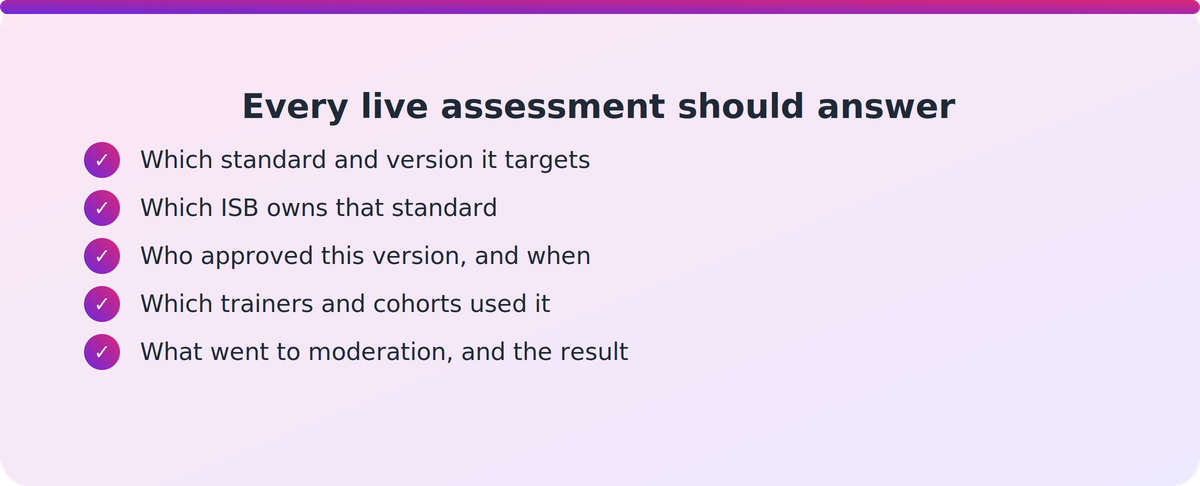
You don't need a grand system to start. You need every live assessment to answer the same few questions, quickly.
- Which standard and version is this written against?
- Which ISB owns that standard?
- Who approved this version, and when?
- Which trainers and cohorts used it, and from what date?
- What was submitted for moderation, and what came back?
Try it on five assessments this month. Where the answers take more than a couple of minutes to find, you've found your real risk.
Key takeaways
- "Current" in 2026 means current against the standard, your consent conditions and what you submitted for moderation, not the newest file.
- Since 1 January 2026, the eight ISBs own standards and national external moderation. Confirm which board owns each of your standards.
- NZQA doesn't prescribe a master copy or version-control standard, but the 2026 QA Rules require an up-to-date quality management system and annual self-review.
- With consistency reviews discontinued, your own evidence of which version was used, by whom, carries more weight.
- Version control is an assurance discipline owned by the Head of Training, not a filing chore.
Our take
Most providers treat version control as housekeeping, something to tidy when time allows. We think that gets it backwards. When the moderator, the standard and the rulebook all shift in the same year, the ability to show exactly what was assessed, against what, is the evidence of assessment quality.
That makes it yours. You're the person who answers when moderation questions consistency, so you should decide what "current" means in your organisation and who signs it off. Don't wait for NZQA to define it, because it won't.
Here's a first step: pick one unit standard, trace it from the ISB that owns it to the last learner you assessed, and see where the trail goes cold.
FAQ
Does NZQA require a master copy of assessment materials?
No. The research found no NZQA rule prescribing a master copy or a specific document-version-control standard. But moderation requires accurate assessment plans and current materials, and the 2026 QA Rules require an up-to-date quality management system. Version control is how you evidence both.
Who moderates my assessments in 2026?
Since 1 January 2026, the eight Industry Skills Boards run national external moderation and maintain industry unit standards. Every industry has been assigned to one board. Check the relevant ISB directly for its moderation process, as published detail varies.
What do the 2026 QA Rules mean for document control?
The Quality Assurance of Tertiary Education Providers Rules 2026 (in force 19 January 2026) require an up-to-date quality management system, annual self-review, and reporting to NZQA. Providers without a system on 1 January 2026 need one before 1 January 2027. Document control fits inside that system.
How does version drift affect assessment consistency?
Criterion 6 of the Programme Approval, Recognition, and Accreditation Rules 2026 requires fair, valid, consistent and appropriate assessment methodology. If trainers use different versions, you can't show consistency. With consistency reviews discontinued from 1 January 2026, that evidence rests with the provider.