TPOF 2025 ASK Unit Format: What RTOs Rebuild First
11 August 2026 · 7 min read
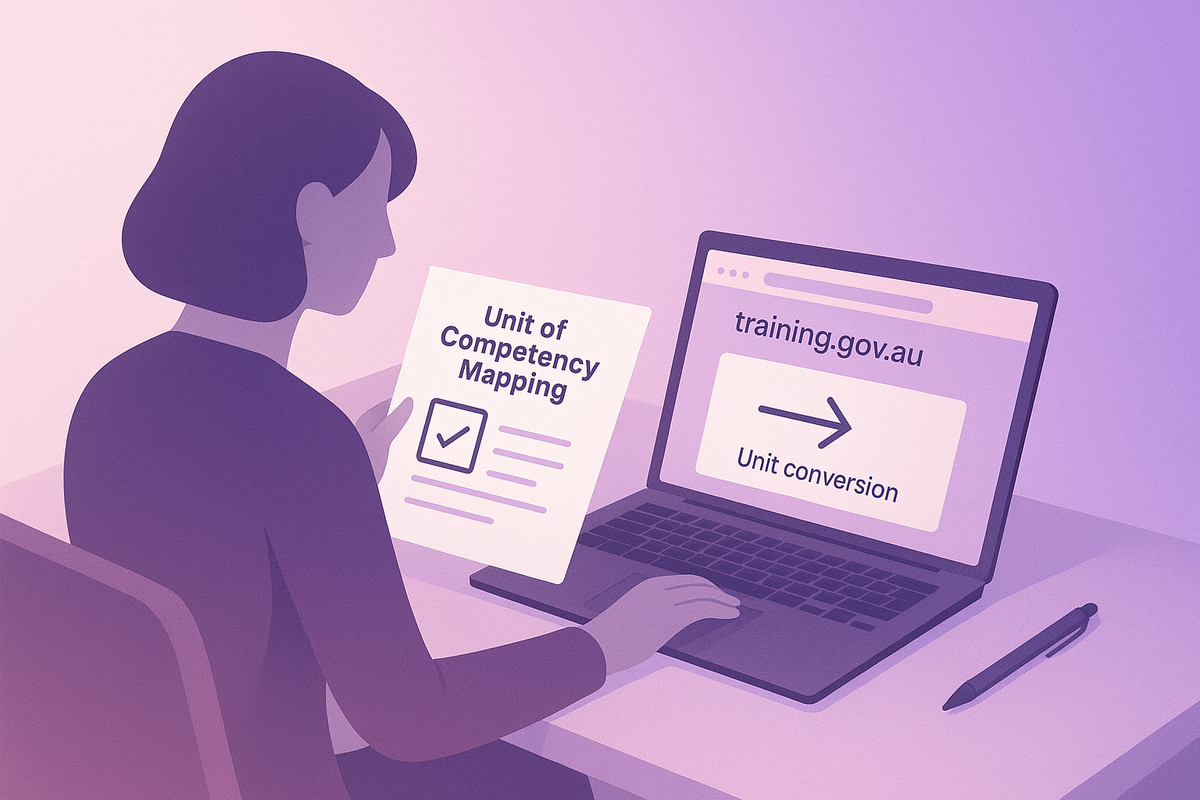
TPOF 2025 is bringing the Application of Skills and Knowledge (ASK) unit format onto training.gov.au, which means units of competency your RTO has already built assessments and training materials against will be reissued in a different structure. For training managers, that's not a formatting update — it's a live re-mapping job across assessment coverage, assessor guides and learning materials, with your audit-defensibility riding on how well you keep pace.
What TPOF 2025 actually changes on training.gov.au
TPOF, the periodic Training Package Products Update process that refreshes units of competency, qualifications and training packages, is rolling out ASK as the new unit structure. Instead of the current arrangement of elements, performance criteria and, in most units, a separate knowledge evidence table, ASK consolidates the skills and knowledge required to perform a task into a single, integrated statement.
That sounds tidy on paper. In practice it means:
- Units you've mapped, assessed and validated against the old structure get reissued with a different shape.
- Any coverage mapping, assessor guide or training material tied to elements and performance criteria in the old format needs checking against the new one.
- This isn't happening all at once. Units convert to ASK progressively as training packages are updated, not on a single cutover date.
That last point matters more than it looks. A one-off migration is a project. A rolling conversion, unit by unit, over months, is an ongoing compliance obligation that has to sit inside business-as-usual, not a single sprint.
The real risk: coverage gaps hiding in plain sight
The ASK format itself isn't the danger — ASQA and the Jobs and Skills Councils (JSC) aren't asking RTOs to reinvent assessment practice from scratch. The danger is the gap it opens between what your assessment library claims to cover and what a converted unit now actually requires.
Every assessment tool, assessor guide and set of training materials your RTO holds is really a claim: this evidence proves competency against this unit. When the unit changes shape underneath that claim, the claim needs re-checking. If it isn't:
- Your coverage mapping documents an old unit structure that no longer matches the current national register entry.
- Assessor guides reference performance criteria your assessors are no longer marking against.
- Training materials teach to gaps or duplications that ASK's integrated skills-and-knowledge statement has already closed.
None of that shows up as a system error. It shows up as a validation finding, or worse, an ASQA audit finding, after the fact.
Where RTOs usually find out too late
Most RTOs track coverage against elements and performance criteria in spreadsheets, mapping documents and document version history — a manual, point-in-time record rather than a live one. That's workable when units are stable. It's a liability when units are converting underneath you.
The pattern is familiar to anyone who has managed a validation cycle:
- Coverage mapping gets done once at course design, then left untouched for years.
- The gap surfaces during a scheduled validation session, when a validator notices the mapping references a unit version that's since been superseded.
- Or, worse, it surfaces during an ASQA audit, when there's no time left to fix it quietly.
With TPOF converting units to ASK progressively, that discovery lag becomes a recurring risk rather than a one-off. Every conversion is a fresh chance for a mapping document to quietly go stale.
What to rebuild first
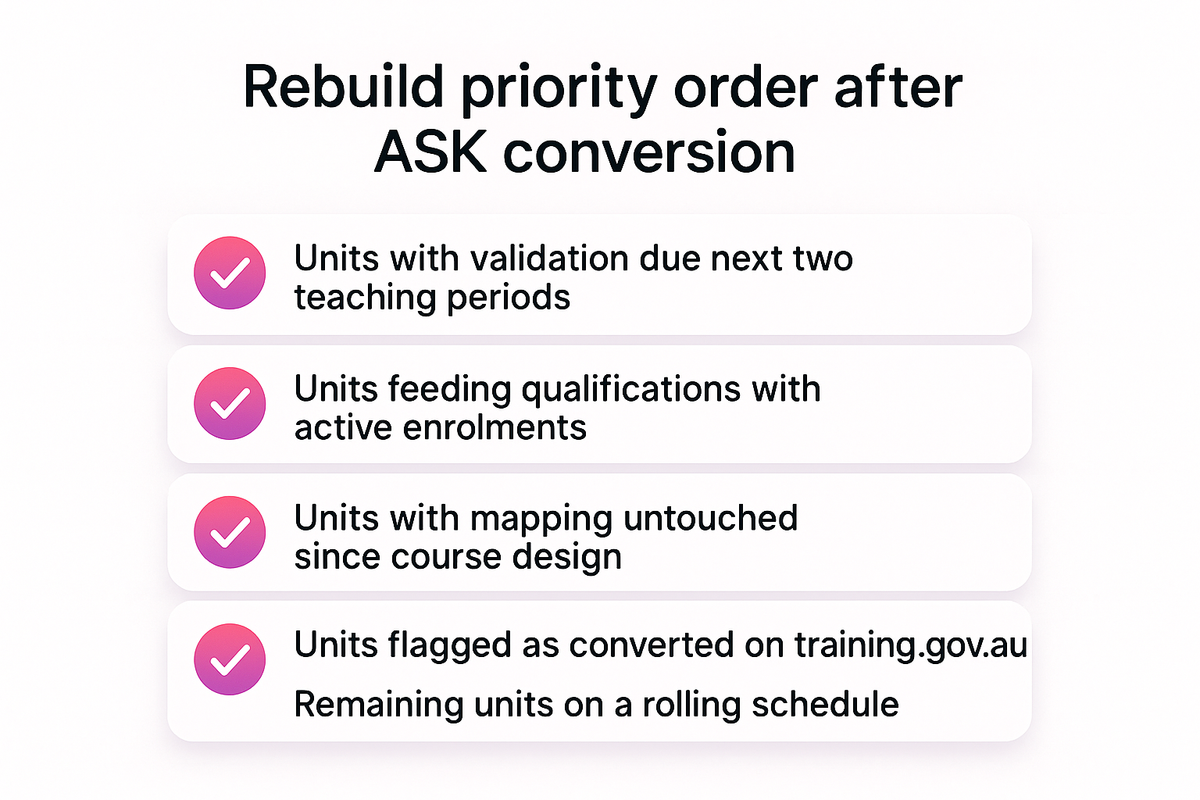
Not every unit in your scope needs the same urgency. A practical starting order:
- Units with validation cycles scheduled in the next two teaching periods.
- Units feeding qualifications with active enrolments right now.
- Units where the existing mapping document hasn't been touched since original course design.
- Units flagged as converted on training.gov.au that you haven't yet cross-checked.
- Everything else, worked through on a rolling schedule rather than all at once.
How some RTOs are approaching the rebuild
The manual approach to this — checking each converted unit's elements and performance criteria against every mapping document, assessor guide and training resource by hand — is exactly the kind of workload TPOF is going to generate at scale. That's why some training providers are looking at platforms built to keep coverage mapping live rather than static.
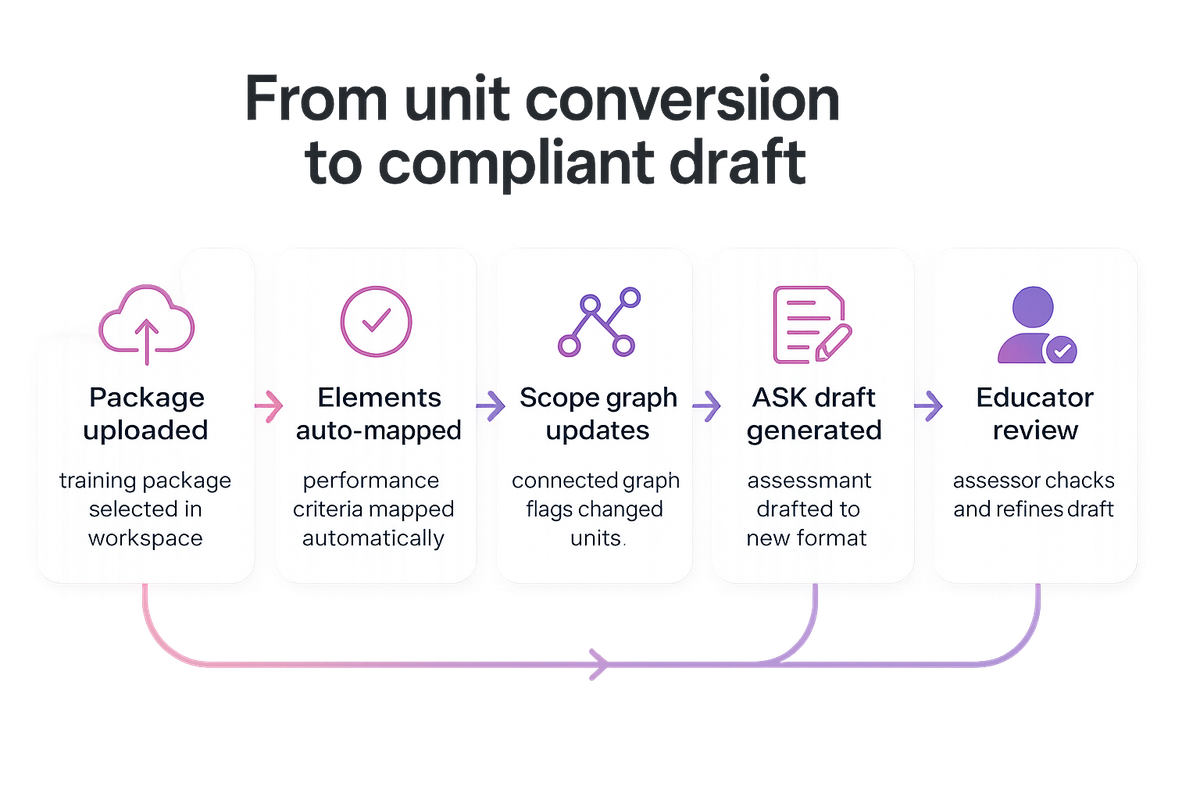
VETos, built specifically for ASQA and JSC-aligned compliance, maps every element and performance criterion automatically when a training package is uploaded or selected, and models a provider's whole scope — training package, qualifications, units, elements and performance criteria — as one connected graph. That structure is what lets a platform actually notice when a unit changes shape, rather than relying on someone remembering to check.
Specifically for the ASK changeover, VETos is built to draft directly to the new unit format and upgrade existing assessment tools as units convert, rather than requiring a rebuild from a blank page for every unit that changes. The output is a compliant assessment draft for an assessor to review and refine, with ASQA-compliant documentation — TAS, LLN, assessment maps, validation records — generated alongside it. The vendor also positions this against a stated sector-average first-time validation pass rate of 68%, framing rework from misaligned coverage as a real, measurable cost of a format change like this one.
None of that removes the need for human judgement. An assessor still has to check the draft against their own cohort and context. But it changes what the TPOF conversion costs a training team: hours of review, instead of weeks of re-authoring per unit.
Key takeaways
- TPOF 2025 introduces the ASK unit format on training.gov.au, reissuing units of competency in a new structure — a workload and compliance event, not a cosmetic update.
- The real exposure is the gap between old mapping and the new unit shape: coverage, assessor guides and materials tied to superseded elements and performance criteria stop being audit-defensible until re-checked.
- Manual, spreadsheet-based coverage tracking tends to surface this gap late, at validation or audit, because it isn't a live record of scope.
- Prioritise units with near-term validation cycles, active enrolments, or stale mapping documents first; work through the rest on a rolling schedule as conversions land.
- Platforms that model scope as a connected, always-current structure — mapping elements and performance criteria automatically and drafting to the new format as units convert — turn this from a rebuild into a review.
Our take
TPOF's rolling, unit-by-unit rollout of ASK is going to expose which RTOs treat coverage mapping as a living compliance record and which treat it as a document written once and filed away. The providers who feel this as a minor annoyance will be the ones already running scope as something continuously checked, not periodically audited. The rest are looking at a slow accumulation of validation findings they won't see coming until a validator, or ASQA, finds them first.
FAQ
What is the ASK unit format under TPOF 2025?
ASK stands for Application of Skills and Knowledge. It's the new unit of competency structure being rolled out to training.gov.au under TPOF 2025, replacing the current elements, performance criteria and separate knowledge evidence table with a single, integrated skills-and-knowledge statement.
Will every unit of competency convert to ASK at once?
No. Units convert progressively as training packages are updated under TPOF, not on one fixed date. That means the compliance workload lands over months rather than in a single cutover, and needs to sit inside ongoing business-as-usual, not a one-off project.
What happens to existing assessments mapped to the old unit structure?
They don't automatically stop being valid, but their coverage claims need re-checking against the new unit shape. Assessment tools, assessor guides and training materials built against superseded elements and performance criteria should be re-mapped and re-validated as each unit converts.
How do I know if a unit I already deliver has converted to ASK?
Check training.gov.au for the current version of each unit in your scope, and compare it against your existing mapping documents. Some platforms, including VETos, model scope as a connected graph specifically so this kind of change is flagged rather than discovered manually.
Can existing training materials be reused after a unit converts?
Often yes, in part. The content usually doesn't disappear, but its structure and coverage need checking against the new integrated skills-and-knowledge statement. Some tools can upgrade existing materials to the new format rather than requiring a full rebuild from scratch.