Scenario-Based Learning Software: RTO Buyer's Guide
12 August 2026 · 7 min read

Scenario-based learning software presents learners with realistic, choice-driven situations — a workplace incident, a difficult client call, a safety scenario — and gives feedback based on what they actually choose, not just what they read. For Australian RTOs, the real test isn't engagement. It's whether that realism, and the paperwork behind it, satisfies the Standards for RTOs 2025 requirement that simulated assessment environments reflect actual workplace conditions.
What scenario-based learning software actually does
Scenario-based learning is an instructional approach, not a single product category. It's built around presenting a realistic decision, letting the learner choose, and giving consequence-based feedback rather than a right/wrong tick. Sources like Articulate and eLearning Industry associate this approach with better knowledge retention and more genuine critical-thinking practice than a static module or a slide deck with a quiz bolted on.
That's a meaningful shift from a standard LMS, which mostly houses and tracks content. Scenario-based tools generate or deliver the practice itself — a role play, a branching decision tree, a simulated client interaction — and the LMS still sits underneath it for enrolment, tracking and reporting.
Does it meet the Standards for RTOs 2025?
The Standards for RTOs 2025 commenced on 1 July 2025, replacing the 2015 Standards, and they apply to every ASQA-registered RTO regardless of size or delivery mode. ASQA guidance is specific on simulated environments: assessment of practical skills via simulation must reflect actual workplace and industry conditions. That's a direct compliance bar, not a nice-to-have, for any scenario-based tool used in assessment rather than just training.
ASQA has also confirmed that role-play scenarios delivered via real-time video are an accepted method for assessing practical and oral skills where cohorts are remote — useful context if you're weighing a simulation tool against face-to-face-only alternatives.
Separately, under Standard 1.4, RTOs must be able to show assessment tools were reviewed before use, and that the review actually fed into changes. That documentation obligation applies whether the tool is a traditional written assessment or an AI-generated scenario. ASQA has also started publishing guidance for providers on using AI responsibly, safely and effectively in VET delivery — worth reading if your shortlist includes anything AI-generated.
Can AI-generated role plays be used for competency assessment?
AI can draft a role play or simulation fast — that's the genuine advantage over building one from scratch. What it can't do is stand in for the qualified assessor who has to judge whether a learner has met a unit of competency. An AI-generated scenario is a starting point for assessment, not a finished, compliance-ready instrument, until a trainer or assessor has checked it against the relevant training package requirements and signed off.
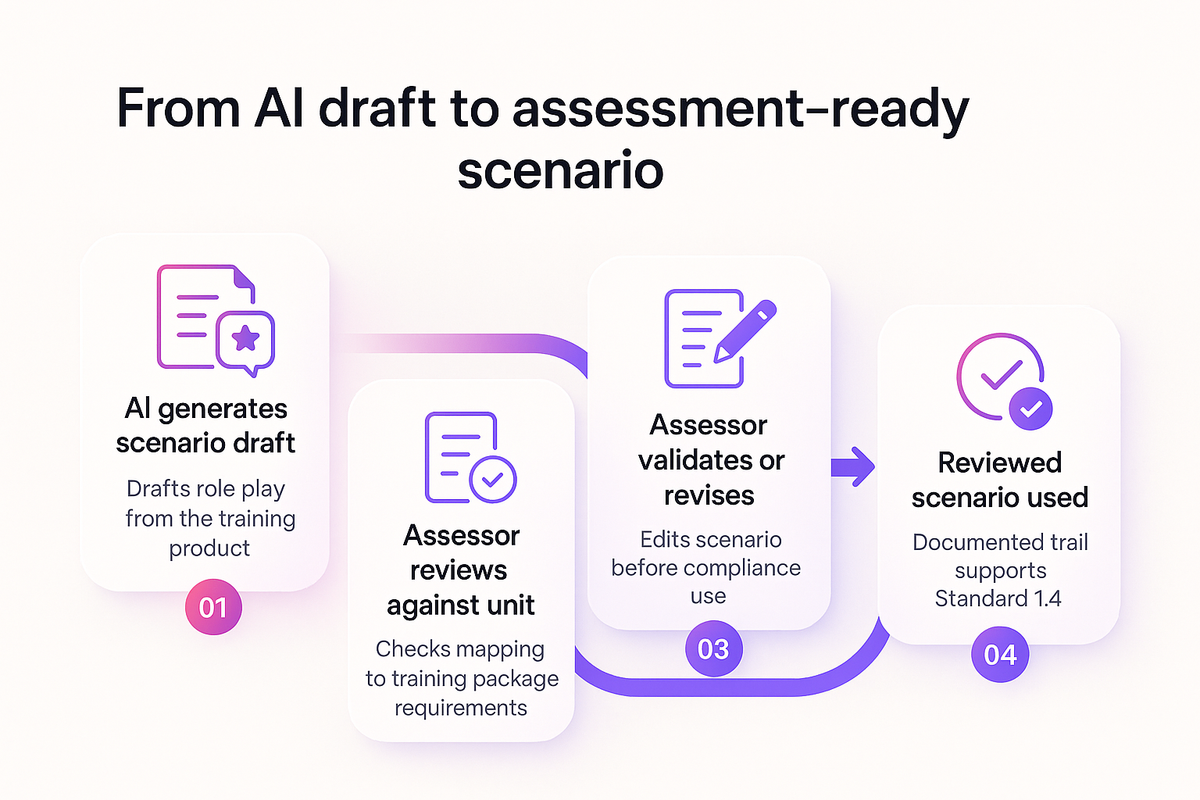
In practice, that means:
- The AI generates a scenario draft from the training product or unit content.
- A qualified assessor reviews it against the unit of competency and training package requirements.
- The assessor validates, edits or rejects it before it's used for a compliance decision.
- The reviewed, signed-off version — with its review trail — is what actually gets used for assessment.
Any vendor implying their AI output can be used for assessment without that human step is asking you to take on risk ASQA has explicitly flagged. The tool speeds up drafting; it doesn't replace judgement.
What should an RTO check before buying?
Generic LMS and authoring-tool buying advice (from sources like Docebo and Teachfloor) still applies here: start from your actual use case, and run a structured pilot with real trainers and learners rather than judging on a demo or a marketing deck. Alongside that, Australian RTOs have a short list of market-specific checks:
- Does scenario realism genuinely reflect actual workplace and industry conditions, or is it generic engagement content dressed up as an assessment tool?
- Can you document a review and validation trail for any AI-generated scenario, consistent with Standard 1.4?
- Does it integrate with your existing LMS, and support SCORM/xAPI and AVETMISS/USI reporting, without a bespoke integration project?
- What are the hosting, data ownership, backup and uptime commitments — this is regulated training data, not marketing content?
- How much trainer and instructional-design time is actually needed to keep scenarios current with training package updates, versus what the vendor claims to automate?

Where AI content-generation engines fit
A newer category of tool sits inside this space specifically for the Australian VET sector: engines that generate role plays, simulations, narrated video, hazard walks and coached calculation practice directly from an RTO's own training products, rather than from generic stock scenarios. VETos's Nova 5 engine, for example, follows a 'learn it, try it, show it' structure per topic — aimed at replacing static, slide-based content with practice — and includes a formative feedback feature where learners upload a practice test or mock assessment and get criterion-by-criterion feedback.
The relevant detail for a buyer is how the vendor frames the human role. VETos describes educators reviewing and refining AI-generated content rather than the AI operating unsupervised — which is the same validation posture ASQA's guidance points to. Whether that's the right fit depends on your training packages, your existing systems and how your assessors want to work; it's one option to weigh against the criteria above, not a default answer.
Key takeaways
- Scenario-based learning is an instructional approach (realistic choices, consequence-based feedback), not a single software category — check what's actually behind the label.
- The Standards for RTOs 2025 (effective 1 July 2025) require simulated assessment environments to reflect actual workplace conditions, and Standard 1.4 requires a documented review trail for assessment tools.
- AI can generate a scenario quickly, but a qualified assessor must validate it against unit of competency requirements before it's used for a compliance decision.
- Check SCORM/xAPI and AVETMISS/USI compatibility, plus hosting and data governance, before any bespoke integration work starts.
- Run a structured pilot with real trainers and learners rather than deciding from a feature demo.
Our take
The realism-versus-compliance question is where most buyers get it backwards: they judge scenario-based tools on how engaging they feel, when ASQA is judging them on how closely they mirror actual workplace conditions and how well the review trail is documented. AI genuinely helps with the slow part — building the scenario — but any vendor selling AI as a replacement for assessor judgement is selling you risk, not a shortcut. Treat the AI as a fast first draft and budget real assessor time for validation; that's the honest way to use this category, not a compromise.
FAQ
What is scenario-based learning software and how is it different from a standard LMS or e-learning module for an RTO?
Scenario-based learning software delivers realistic, choice-driven practice — role plays, simulations, branching decisions — with feedback tied to the learner's choices, rather than static content and quizzes. A standard LMS typically hosts, tracks and reports on that content; scenario-based tools generate or deliver the practice itself.
Does scenario-based learning software meet ASQA's Standards for RTOs 2025 requirements for simulated assessment environments?
It can, but it isn't automatic. ASQA requires that assessment of practical skills via simulation reflect actual workplace and industry conditions, and Standard 1.4 requires a documented review of assessment tools before use. A tool only meets these requirements if the scenario is genuinely workplace-realistic and the RTO can show the review trail.
What should an RTO check before buying scenario-based learning software?
Check scenario realism against ASQA's workplace-conditions bar, confirm SCORM/xAPI and AVETMISS/USI compatibility, ask about hosting, data ownership, backup and uptime, and run a structured pilot with real trainers and learners rather than judging on a demo.
Can AI-generated role plays or simulations be used for competency assessment, or do they still need a trainer or assessor to validate them?
AI-generated scenarios still need a qualified assessor to validate them against training package requirements before they're used for a compliance decision. AI can speed up drafting, but the assessor's review and sign-off is what makes the output usable for assessment.
Are AI-generated role plays accepted for remote or online assessment?
ASQA guidance recognises role-play scenarios delivered via real-time video as an accepted method for assessing practical and oral skills where cohorts are remote, alongside other online training and assessment approaches.