The Board Dashboard Every NZ PTE CEO Still Lacks
12 August 2026 · 7 min read

A PTE's regulatory standing, financial trajectory and enrolment pipeline currently sit in at least four separate systems and reporting cycles — and most CEOs only see them together when NZQA, TEC or the board forces the issue. That's not a data problem. It's a governance blind spot, and 2026 is about to make it more expensive to ignore.
Why this lands on your desk
Your NZQA External Evaluation and Review (EER) outcome is the closest thing a PTE has to a credit rating. It carries direct incentives or sanctions, and boards increasingly expect you to report on it before you're asked — not after a report lands.
At the same time, the compliance calendar itself is changing under the Private Training Establishment Rules 2026. The Annual Maximum Fee Movement (AMFM) is capping your main pricing lever just as delivery and compliance costs keep climbing. And the disestablishment of Te Pūkenga is redrawing the competitive map you operate in. None of this is optional reading — it's what you'll be asked to explain at the next board meeting.
The four streams that never sync up
Every PTE CEO is effectively running four dashboards that were never built to talk to each other:
- NZQA's EER confidence ratings — two statements of confidence (educational performance, and capability in self-assessment) that together set your provider category. Published reports show real providers ranging from "Not Yet Confident" through to "Highly Confident" — a wide spread with real consequences attached.
- TEC audit findings — a separate compliance signal, assessed against its own focus areas. One published example found a provider's systems "acceptable, with minor nonconformities," with only six of twelve focus areas fully compliant. That's a materially different lens to EER, sitting in a different system entirely.
- The NZQA compliance calendar — registration maintenance, reporting deadlines and now a changed reporting cadence under the 2026 Rules.
- Enrolment and financial trends — the numbers your board actually asks about first, and the ones most disconnected from the other three.
If you can't see all four in one place, you're not managing risk — you're discovering it.
What the 2026 Rules change about your compliance calendar
From 19 January 2026, the Private Training Establishment Rules 2026 replace both the 2025 Rules and the 2022 Enrolment Rules. Two changes matter directly to how you plan your year:
- The annual NZQA fee is removed.
- Most non-funded PTEs move to biennial financial returns, unless NZQA specifically notifies you otherwise.
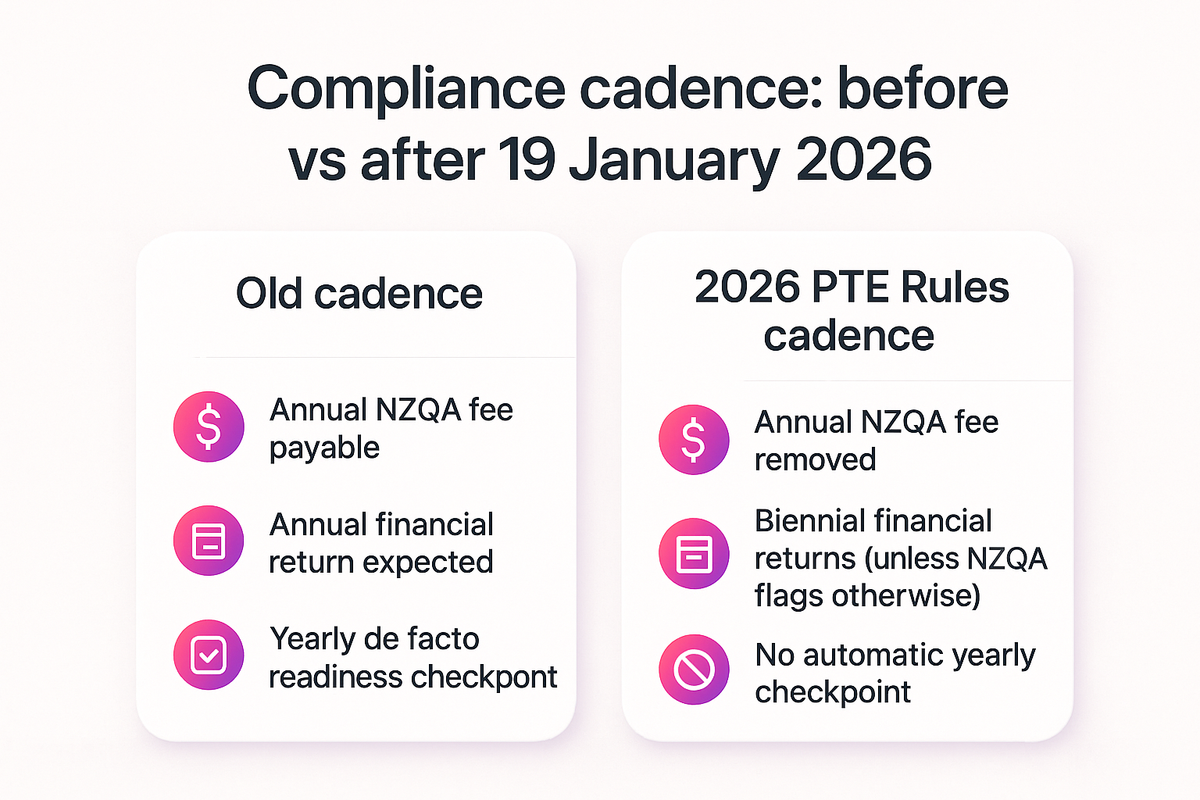
On paper that's less admin. In practice, it removes the annual forcing function that used to catch small issues before they compounded. "Audit-ready" now has to mean continuously ready, not ready-by-deadline — because the deadline itself just got twice as far away.
Why price can't rescue your margin anymore
The AMFM caps domestic fee increases for TEC-funded, NZQF level 3-and-above courses at a proposed 6.0% for 2026. Exception applications exist, but they're limited to courses priced below the 75th percentile, and the number of exceptions per provider is capped too.
That closes off the lever CEOs have traditionally pulled when compliance and delivery costs rise. If you can't raise price freely, margin protection has to come from somewhere else — and the only place left is visibility: knowing your cost-per-student, your delivery efficiency and where your operating cost is actually going, in real time rather than at year-end.
The sector is being reshaped around you, not by you
From 1 January 2026, Te Pūkenga is disestablished and replaced by 10 regional polytechnics and new Industry Skills Boards. The Ministry of Education's own advice has flagged the financial viability of some polytechnics as a key risk — this is sector-wide instability, not a rumour.
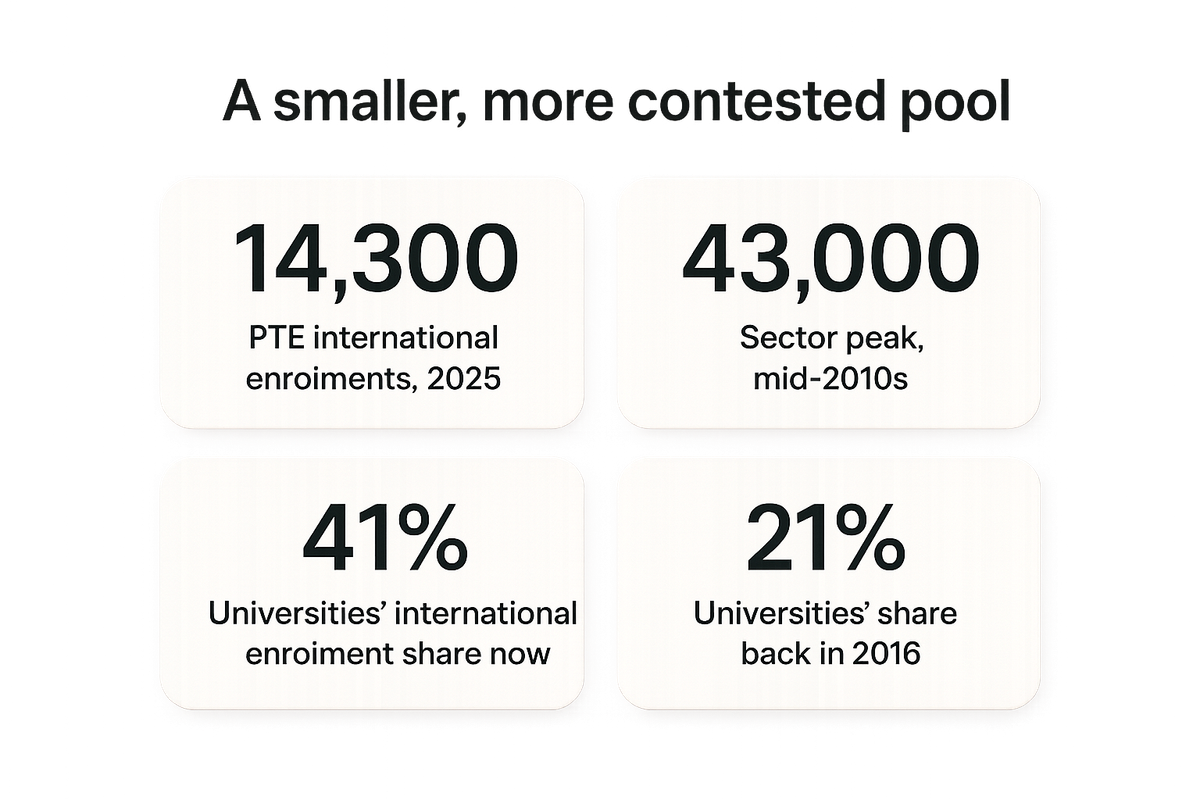
Meanwhile, the growth story every board wants to hear has changed shape. PTE international enrolments recovered to around 14,300 in 2025 — still well short of the sector's mid-2010s peak of roughly 43,000. Over the same period, universities' share of international enrolments climbed to 41%, up from 21% in 2016. "Growth" for a PTE now means growing share inside a smaller, more contested pool — a very different number for your board pack than a simple year-on-year enrolment comparison.
AI is already inside the building — governance is the open question
There is no PTE-specific AI regulation in New Zealand. The national approach is deliberately light-touch and principles-based, leaning on existing law — the Fair Trading Act, the Human Rights Act, the Privacy Act — rather than a dedicated framework.
That hasn't stopped adoption. TEC-funded predictive-analytics pilots are already flagging at-risk learners for pastoral follow-up, and providers are piloting AI in admissions, timetabling and compliance reporting. Your staff and systems are moving faster than the regulatory framework — which means AI governance inside your PTE is currently a judgement call for your board, not a box you can tick against a standard.
Key takeaways
- Your EER confidence category functions like a credit rating — report on it proactively, not reactively.
- From 19 January 2026, the PTE Rules 2026 shift most non-funded providers to biennial financial returns and remove the annual NZQA fee — plan for continuous readiness, not deadline-driven readiness.
- The AMFM's proposed 6.0% cap for 2026 limits price as a margin lever; cost-per-student visibility has to do the work instead.
- Te Pūkenga's disestablishment and the rise of university-based international enrolment (41% share, up from 21% in 2016) mean "growth" needs redefining in your board reporting.
- AI adoption in NZ vocational education is running ahead of any dedicated regulatory framework — governance of it is a board decision, not a compliance checklist item.
Our take
The missing dashboard isn't really a technology gap — it's a design gap. NZQA and TEC run separate processes by design, financial reporting now runs on its own multi-year cycle, and enrolment data lives wherever your admissions team keeps it. Nobody built these four streams to meet in one place, so nobody should be surprised they don't.
That means the synthesis is your job, not a system's. The CEOs who come out of the 2026 restructuring in the strongest position won't be the ones with the best individual reports — they'll be the ones who can put EER standing, TEC findings, cost-per-student and enrolment trajectory on one page and read it monthly, not annually. Treat it as a governance habit before it becomes a governance requirement.
FAQ
What are NZQA's two EER statements of confidence, and why do they matter for board reporting? EER produces two separate statements — one on educational performance, one on capability in self-assessment — which together determine a provider's confidence category. Published reports show outcomes ranging from "Not Yet Confident" to "Highly Confident," and the category carries real incentives or sanctions, making it the single most board-relevant compliance metric a PTE has.
How does the Private Training Establishment Rules 2026 change my reporting calendar? From 19 January 2026, the 2026 Rules replace the 2025 Rules and the 2022 Enrolment Rules. The annual NZQA fee is removed, and most non-funded PTEs move to biennial financial returns unless NZQA notifies otherwise — a longer cycle that removes the yearly checkpoint many providers used as a de facto readiness deadline.
What is the Annual Maximum Fee Movement and how does it limit pricing? The AMFM caps domestic fee increases for TEC-funded, NZQF level 3-and-above courses — a proposed 6.0% for 2026. Exception applications are restricted to courses priced below the 75th percentile, with a capped number of exceptions per provider, meaning fee increases can no longer be relied on to offset rising compliance or delivery costs.
How does the Te Pūkenga reform affect a PTE's competitive position? From 1 January 2026, Te Pūkenga is disestablished and replaced by 10 regional polytechnics and new Industry Skills Boards. The Ministry of Education has flagged financial viability risk for some polytechnics, signalling instability in funding and competitive relationships that will ripple through to PTEs' enrolment and partnership decisions.