NZQA Unit Standard Review Process: A COO's 2026 Playbook
17 August 2026 · 8 min read

Every unit standard you deliver against carries a review date, and NZQA expects the qualification developer to start that review well ahead of it — for new unit standards, typically around five years out. Most providers still treat each review as a one-off scramble when the notice lands. In 2026, that habit runs headlong into the biggest structural reshuffle the sector has seen in a decade.
Why this lands on your desk, not just compliance's
It's tempting to file standard reviews under "compliance owns that." But the review cycle is really an operations problem wearing a compliance costume. It touches capacity planning, document control, reporting integrity and revenue continuity — all things you're accountable for.
Here's the mechanics. NZQA requires the qualification developer to run a formal review before a qualification or unit standard's listed review date, consulting industry stakeholders as part of the process. That's predictable, recurring work — closer to payroll than to an audit surprise. But a standard can also be reviewed and changed mid-stream, before a learner enrolled against the old version even finishes their qualification. Your assessors are expected to assess against the current version regardless. If moderation turns up non-compliance because someone was working off a superseded standard, NZQA can be notified, and the consequence on the table is recommended removal of consent to assess. That's not a paperwork problem. That's a program you can no longer legally deliver, with enrolled students already inside it.
Layer on 2026's rule changes and the reporting platform migration, and you've got three separate moving parts that all have to reconcile on the same calendar: what needs reviewing, who now owns that review, and where the resulting data gets reported.
The review cycle was always a standing job
Under the New Zealand Qualifications and Credentials Framework, qualifications and standards aren't set-and-forget. Each one is listed with a review date, and the qualification developer is on the hook to run that review — consulting industry — ahead of it lapsing. For a provider holding scores of unit standards across several qualification suites, that means a rolling schedule of reviews landing in different months, indefinitely. Treating each one as a fresh project means re-discovering, every time, who's meant to be doing what.
2026 changes the shape of the work, not just the date
From 19 January 2026, three sets of new NZQA rules replaced the 2025 versions. Two matter directly to how you run operations.
The Qualification and Micro-credential Listing and Operational Rules 2026 alter review periods and introduce an "expiring" status for qualifications that haven't been reviewed, or haven't had anyone awarded against them, within a set window. Consistency reviews are formally discontinued from 1 January 2026. If your qualification tracking has been informal — a spreadsheet someone updates when they remember — an expiring qualification can slip past you until a learner can no longer be awarded against it.
The Programme Approval, Recognition, and Accreditation Rules 2026 go further: they replace external evaluation and review with provider-led self-review and monitoring, and reduce approval requirements for programmes built entirely from skill standards. That sounds like less red tape. In practice, it moves the quality assurance workload that NZQA used to check externally onto your own systems and people. Self-review only works if someone owns the schedule, the evidence and the follow-up — permanently, not as a once-a-year fire drill.
Ownership is shifting mid-cycle
The Vocational Education and Training reform legislation passed in October 2025 disestablished Te Pūkenga and, from 1 January 2026, created ten regional polytechnics and eight Industry Skills Boards, with ISBs managing work-based training for up to two years during the transition. Standard-setting bodies that used to be Workforce Development Councils are becoming Industry Skills Boards, and the qualification suites they're responsible for are moving with them.
That matters for you because a standard's custodian, contact point and review timetable can change hands mid-cycle. If your team is still directing queries or review submissions to a body that no longer holds that portfolio, you've got a communication gap dressed up as a compliance gap. Before your next review lands, confirm — in writing, per qualification suite — which body now owns it.
The reporting plumbing moved too
Single Data Return and Indicative Enrolment Collection reporting — the backbone of your TEC funding and monitoring data — has moved onto the new DXP Ngā Kete data exchange platform, replacing the old SDR Manual and website-based specifications. Whatever your team's muscle memory was for submission format, validation checks and error resolution, some of it no longer applies. That's a systems-integration and retraining task sitting on top of the standard review workload, not instead of it.
PTE-specific calendar changes
If you operate as a Private Training Establishment, the Private Training Establishment Rules 2026 remove the annual PTE fee and move non-funded PTEs to biennial financial return submissions rather than annual, unless NZQA directs otherwise. That's welcome relief on frequency — but it's still a calendar change your reporting team needs built into next year's schedule, not assumed to run on autopilot. Separately, PTEs must retain all student assessment materials, or full copies, for at least 12 months after course completion, including materials produced by sub-contractors. That's a record-keeping obligation that sits alongside, and often gets forgotten during, the busier work of a live standard review.
Building the review cycle into standing operations
The fix isn't heroics during review season. It's treating the review cycle the way you already treat payroll or lease renewals — a standing function with an owner, a calendar and allocated capacity, independent of who's busy that month.
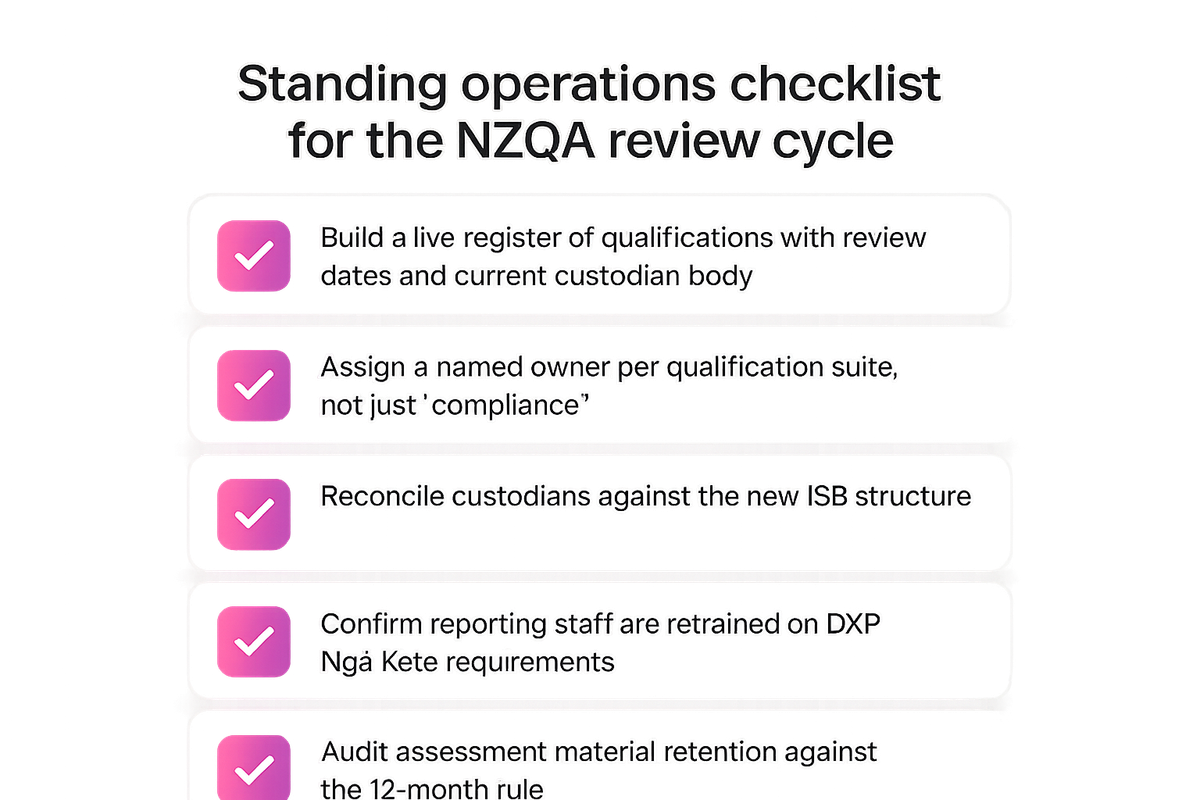
A few things worth doing this quarter:
- Build a live register of every qualification and unit standard you hold consent to assess against, with its review date and current custodian body.
- Assign named ownership for tracking each qualification suite's status — not "compliance," a person.
- Reconcile that register against the new ISB structure so nobody is emailing a defunct WDC address.
- Confirm your reporting team has been retrained on DXP Ngā Kete submission requirements, not just the old SDR Manual.
- Check assessment material retention practices, including anything held by sub-contractors, against the 12-month rule.
Key takeaways
- NZQA's review cycle is a recurring operational obligation, not an occasional project — new unit standards carry a planned review date around five years out.
- Assessing against a superseded standard risks moderation findings that can lead to recommended removal of consent to assess — a direct revenue and delivery risk.
- From 19 January 2026, new NZQA rules introduce "expiring" status for unreviewed qualifications and shift quality assurance toward provider-led self-review.
- Standard ownership is moving mid-cycle as Te Pūkenga is disestablished and Workforce Development Councils become Industry Skills Boards — confirm current custodians per qualification suite.
- SDR/IND reporting has migrated to the DXP Ngā Kete platform, and PTEs face changed fee and financial return schedules under the Private Training Establishment Rules 2026.
Our take
We think the sector's biggest operational risk this year isn't any single rule change — it's the assumption that standard reviews are episodic. They never were. What's changed is that the entities you rely on to tell you what's due, who owns it and where to report it have all shifted at once. A provider with a live, owned register of its qualification portfolio will absorb this. A provider running on institutional memory and a shared drive won't find out until moderation, an expiring-status notice, or a funding query tells them the hard way.
FAQ
How often does NZQA require a unit standard or qualification to be reviewed? NZQA expects the qualification developer to begin a formal review before a qualification's listed review date. New unit standards typically start with a planned review date around five years from creation, making review a recurring, schedulable operational task rather than a one-off event.
What happens if we keep assessing against a standard version that's been superseded? Providers remain responsible for assessing against the current version of a standard. Non-compliance identified through moderation can be reported to NZQA and may result in a recommendation to remove consent to assess — a direct risk to programme delivery and revenue.
Who do we report to now that Workforce Development Councils are becoming Industry Skills Boards? From 1 January 2026, Industry Skills Boards are taking over standard-setting responsibilities previously held by Workforce Development Councils, and ISBs are managing work-based training for up to two years during the transition. Confirm current custodianship per qualification suite rather than assuming past contacts still apply.
Does the move to self-review under the 2026 Programme Approval, Recognition, and Accreditation Rules reduce our workload? Not necessarily. The rules replace external evaluation and review with provider-led self-review and monitoring, which reduces NZQA's direct check-ins but shifts the ongoing quality assurance effort — and the evidence trail to support it — onto your own operational systems and people.