NZQA Evidence Audit Readiness: The 24-Hour Test
13 August 2026 · 7 min read

NZQA no longer books you in for an audit. From 1 January 2026 it stopped opening new External Evaluation and Review processes altogether, and the on-site inspection powers under the Education and Training Act 2020 mean a request for your quality management system can land on any given Tuesday, with no notice and no grace period.
Why this lands on your desk now
For years, the Compliance Manager's job had a rhythm. You knew roughly when the next EER was coming, you built toward it, and the category rating that came out the other end told you — and your board — where you stood. That rhythm is gone.
The new Quality Assurance of Tertiary Education Providers Rules 2026 don't give you a date to prepare for. They give you a standing obligation: hold a functioning quality management system, keep it current, and be able to produce it to NZQA on request, at any time. If you don't have a compliant system in place as at 1 January 2026, you have until 1 January 2027 to build one. After that, there's no more runway.
This changes what you're judged on. It's no longer "how did we score last time." It's "could you hand this over right now, this afternoon, if someone asked."
What actually changed on 1 January 2026
Three things shifted at once, and they compound each other:
- NZQA stopped starting new EER processes. Providers now submit an annual self-review summary report and meet NZQA to discuss an improvement plan — a conversation, not a scored inspection.
- Category ratings tied to EER cease along with it. There's no more periodic scorecard to track or report up to your board.
- The Quality Assurance of Tertiary Education Providers Rules 2026 replace the 2022 EER Rules, requiring organisational self-review every calendar year and a QMS that's genuinely operational, not just a document sitting on a shared drive.
Taken together, this moves the goalposts from periodic demonstration to continuous capability. You're not preparing for a moment anymore. You're maintaining a state.
The 24-hour test, literally
Here's the part that should concentrate the mind: NZQA's inspection powers under the Education and Training Act 2020 aren't new, but they matter more now that they're the only real check in the system. Inspectors can enter premises and require production of documents or information — electronic or paper — without the cushion of a scheduled review process sitting between you and the request.
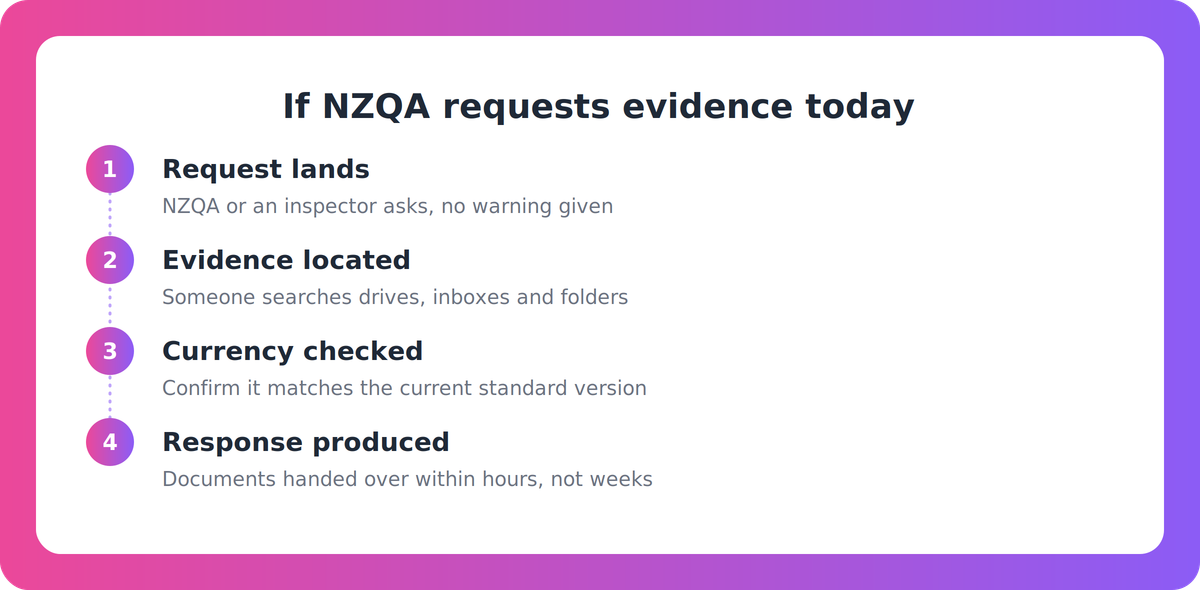
That's not a hypothetical scenario for a risk register. It's a live regulatory possibility every week your organisation operates. The practical question is simple: if that request came in this afternoon, how long would it take you to assemble a current, accurate, defensible response?
If the honest answer involves phrases like "let me check with a few people" or "I think that's in someone's inbox," that's the gap NZQA's new model is specifically designed to expose.
Where the evidence gaps actually live
Most providers don't fail this test because they're non-compliant. They fail it because their evidence is scattered — across drives, inboxes, spreadsheets, and whichever staff member happened to own a task two managers ago.
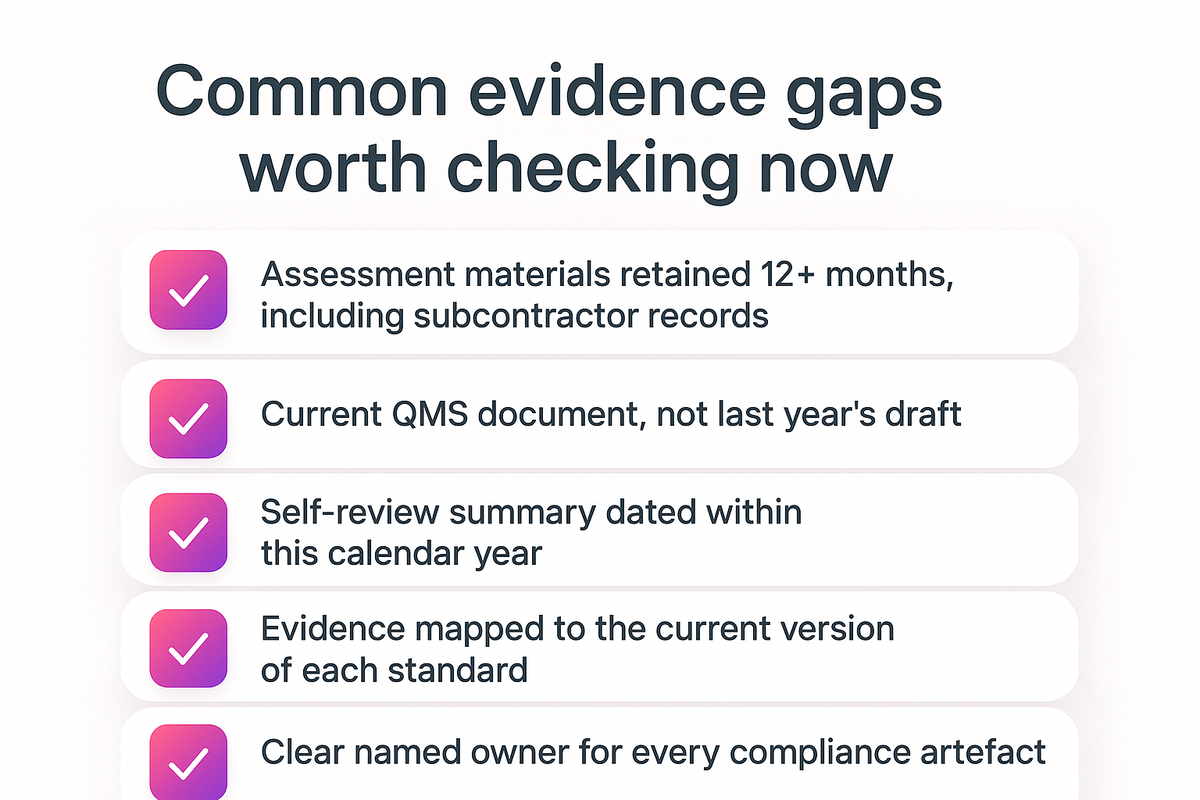
The PTE Rules 2026 add a concrete, time-bound layer to this: all student assessment materials, including those produced by sub-contractors, must be retained for at least 12 months from completion of the relevant training. That's a specific, auditable obligation, not a general principle — and subcontractor records are exactly the kind of thing that quietly falls outside your normal filing habits.
The risk of letting evidence gaps drift is real and documented. NZQA's handling of Excellent International Academy in Auckland shows how compliance concerns first raised around assessment and moderation practices, left unresolved over time, escalated all the way to an intention to cancel registration. The failure wasn't one dramatic breach — it was years of gaps nobody closed.
Keeping pace with standards churn
The evidence you hold also has to stay current against a moving target. Te Pūkenga was disestablished from 1 January 2026, and eight new Industry Skills Boards have replaced the former Workforce Development Councils. NZQA and the ISBs are now co-designing replacement skill standards sector by sector — the Services ISB's 2026 review of the Sport, Exercise, and Leisure Operations qualifications and unit standards is a live example.
Every one of those reviews can quietly outdate a TAS, an assessment tool, or a mapping document you filed as compliant last year. Part of the 24-hour test isn't just "can you find the evidence" — it's "is the evidence you find actually current against the version of the standard NZQA is applying today."
There is some relief in the mix. PTEs no longer file a separate Annual Financial Return, and many non-funded PTEs have moved to biennial financial reporting. That's a genuine reduction in one kind of administrative load — but it's happening alongside a tightening of continuous evidence obligations, not instead of it. The burden is shifting shape, not shrinking.
Key takeaways
- EER audits and category ratings are gone; providers now file annual self-review summaries and must hold a QMS producible to NZQA at any time, with a hard deadline of 1 January 2027 for those not already compliant.
- NZQA's statutory powers under the Education and Training Act 2020 to enter premises and demand documents make an unannounced request a genuine operational risk, not a compliance-calendar entry.
- The PTE Rules 2026 require assessment materials, including subcontractor-produced ones, to be retained for at least 12 months — a specific record-keeping duty worth checking against your current filing habits.
- Standards themselves are moving: Te Pūkenga's disestablishment and the new Industry Skills Boards mean unit and skill standards are being reviewed sector by sector, so evidence that was compliant last year may not map to the current standard today.
- Slow-building, unresolved gaps escalate — as NZQA's handling of Excellent International Academy shows — so treating self-review as a genuine annual discipline matters more than treating it as paperwork.
Our take
The old audit cycle did Compliance Managers a favour it never got credit for: it forced a periodic, organisation-wide tidy-up, whether people liked it or not. Losing that rhythm is uncomfortable, but it's also honest. A quality management system that only gets assembled properly once every few years for an inspector was never really a working system — it was a performance.
The providers who'll do well under this model aren't the ones who scramble hardest when asked. They're the ones who've made evidence ownership boring: every document has a named owner, every piece of assessment material is dated and mapped to the standard version it satisfies, and self-review happens on the calendar whether or not anyone's watching. That's not a compliance ideal. It's just what continuous obligation actually requires.
FAQ
Do I still need to prepare for an EER audit? No. From 1 January 2026, NZQA stopped starting new External Evaluation and Review processes, and category ratings tied to EER cease with it. The replacement is an annual self-review summary report and a discussion with NZQA about an improvement plan.
What's the actual deadline for having a compliant quality management system? Under the Quality Assurance of Tertiary Education Providers Rules 2026, providers without a compliant QMS as at 1 January 2026 have until 1 January 2027 to have one in place, ready to produce to NZQA on request.
Can NZQA really turn up and demand documents without warning? Yes. NZQA holds statutory inspection powers under the Education and Training Act 2020, including entering premises and requiring production of documents or information, whether held electronically or on paper.
How long do we need to keep assessment materials now? Under the PTE Rules 2026, providers must retain all student assessment materials — including those produced by sub-contractors — for at least 12 months from completion of the relevant training.
When was the last time you actually timed how long it would take to produce your current QMS, start to finish, if the request came in right now?