Immersive Learning Platforms NZ: A Buyer's Guide
17 August 2026 · 9 min read
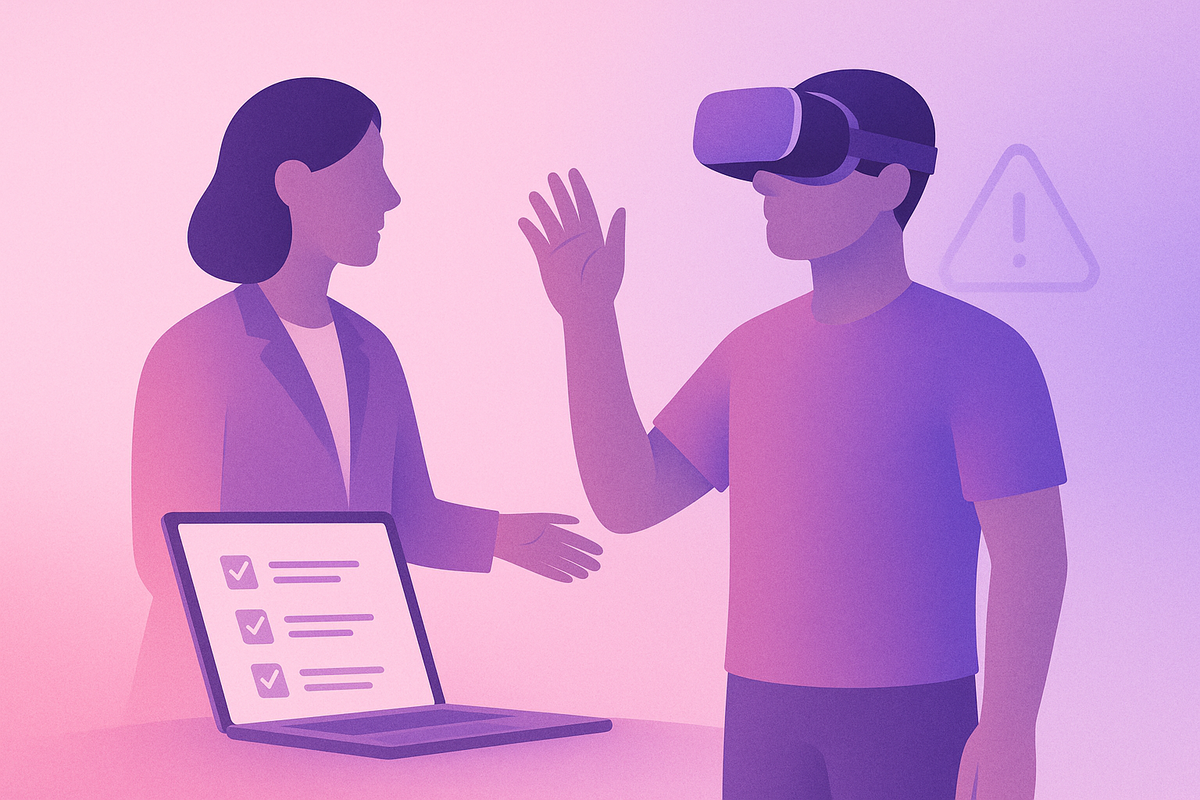
An immersive learning platform for New Zealand vocational training is any VR, AR, 360-degree video or AI-generated simulation that lets learners rehearse real work tasks — including high-risk ones — without real-world consequences. The real test isn't the technology: it's whether the content maps to NZQA-recognised standards, moves data cleanly into your existing systems, and still passes through a qualified human before it counts toward assessment.
What counts as an immersive learning platform, and how is it different from a standard LMS?
A standard LMS delivers content: video lectures, PDFs, multiple-choice quizzes, maybe a discussion forum. Learners consume information and get tested on recall. An immersive learning platform builds a practice environment instead — a simulated customer complaint, a mock medical emergency, a virtual worksite hazard — where the learner has to act, and the platform responds to what they do (ELM Learning; Treedis).
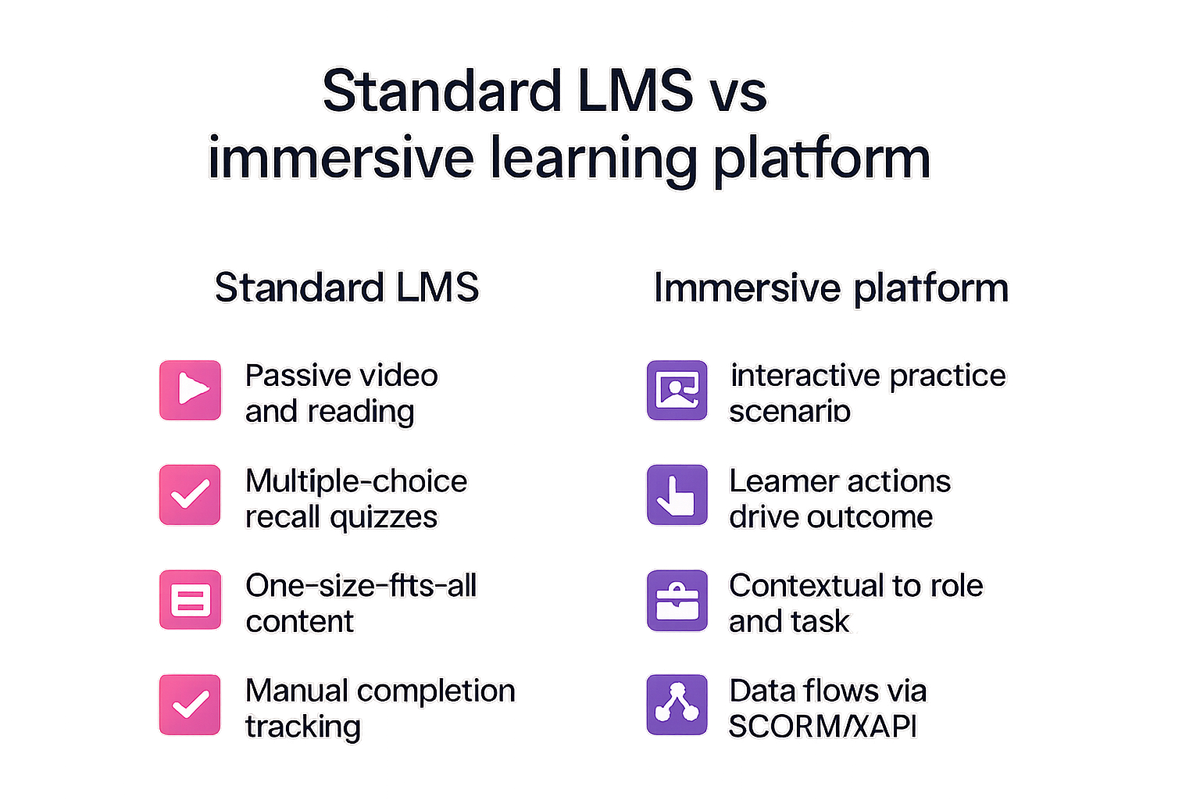
That distinction matters most for high-stakes or high-risk vocational skills: aged care, trades, hospitality service recovery, workplace safety. A systematic review of augmented reality in vocational training found the format's real value sits in letting learners practise procedures that would be expensive, dangerous or logistically difficult to repeat in real life (ScienceDirect, 2021). The delivery mechanism can be a headset, a browser-based 3D scene, 360-degree video, or an AI-generated role-play with a synthetic character responding in real time — the common thread is interactivity and consequence-free repetition, not any specific hardware.
Why NZ's vocational sector reshuffle changes what 'compliant' means right now
New Zealand's vocational education system is mid-restructure, and that affects how a buyer should read any vendor's compliance claims. Te Pūkenga was disestablished under legislation passed in October 2025 and replaced, for a two-year transitional period, by the New Zealand Institute of Skills and Technology (NZIST); the country's ten regional polytechnics became independent organisations from 1 January 2026 (Beehive.govt.nz; Ministry of Education). New Industry Skills Boards are taking over standard-setting and, transitionally through to the end of 2027, some of the work-based training oversight Te Pūkenga previously held (Ministry of Education; Tertiary Education Commission).
NZQA remains the quality-assurance regulator for non-university tertiary providers, requiring compliance with rules made under the Education and Training Act 2020 and periodic external evaluation and review (EER). NZQA has also updated its Rules to align with a new integrated Quality Assurance Framework, taking effect from 19 January 2026, and unit standards are progressively converting to skill standards on the NZQA directory. There's no publicly documented NZQA-specific technical standard for immersive or VR learning tools — so treat NZQA's programme approval and EER rules as the actual compliance layer, and use general interoperability and accessibility standards (SCORM, xAPI, WCAG) as your practical proxy for platform quality.
The compliance and integration checklist to run before you sign
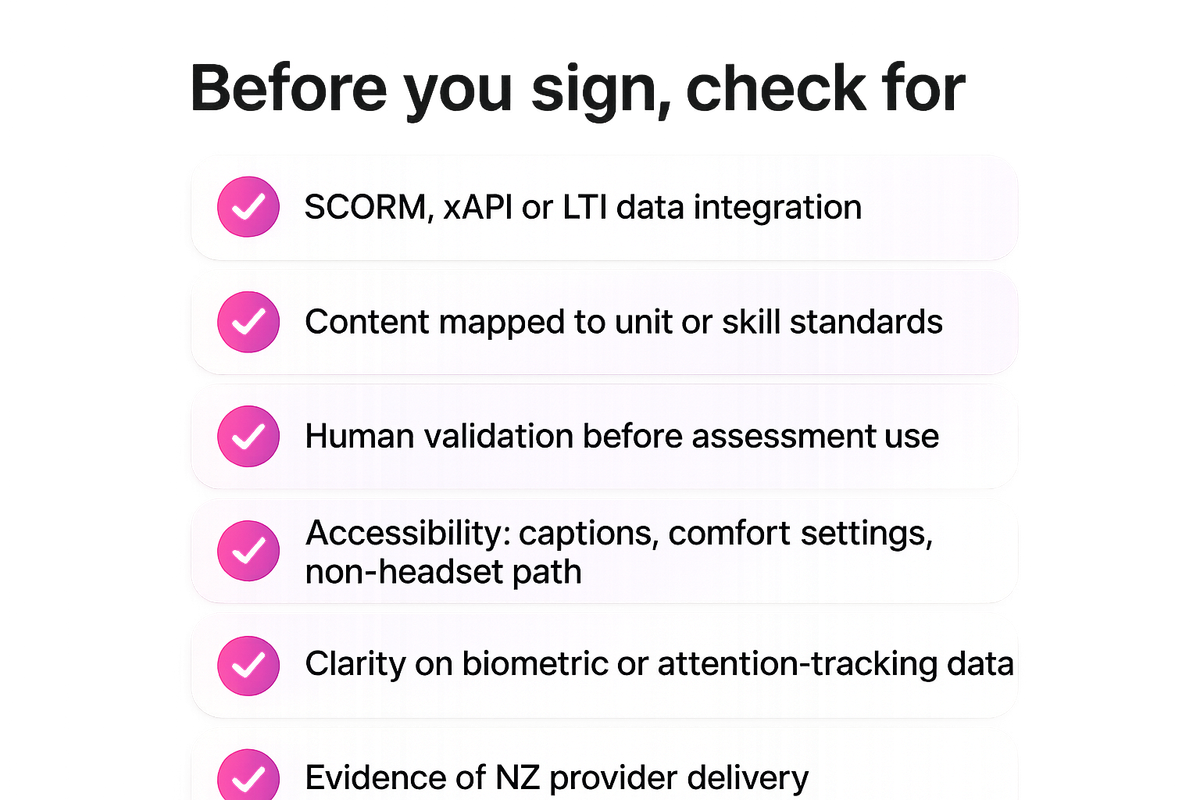
Before any demo turns into a contract, weigh the platform against these checks:
- Standards and data interoperability — does it support SCORM, xAPI or LTI, so completion and performance data lands in your existing systems rather than a manual spreadsheet workaround?
- Mapping to NZ qualification structures — can simulations, role-plays or assessments be traced to specific unit standards, skill standards or graduate profile outcomes, ready for moderation?
- Human validation and accountability — does the vendor's process keep a qualified person checking and signing off content before it's used for assessment, rather than treating AI output as final?
- Accessibility provisions — comfort settings, captions or transcripts, an alternative non-headset pathway, and ideally documented conformance information (Enabled.in).
- Data privacy and biometric scope — clarity on what's actually captured (attention, gaze, emotion) and whether that brings the platform inside the Biometric Processing Privacy Code.
- Defined outcome fit — is there a specific behavioural or completion outcome the immersive format is meant to shift, tested against a cheaper e-learning alternative (IGIVU)?
- Deployment and hardware realism — headset-dependent or browser/web-based, and whether that suits your learners' access and your budget.
- Evidence of NZ-specific delivery — has the vendor actually delivered NZQA-aligned content for a New Zealand provider, not only overseas case studies?
Does VR/AR or AI role-play data trigger NZ privacy obligations?
Possibly — depending on what the platform actually captures. New Zealand's Biometric Processing Privacy Code was finalised on 6 August 2025 and began applying to new biometric collection from 3 November 2025, with a compliance runway to 3 August 2026 for processing already under way (Office of the Privacy Commissioner). Ordinary consumer VR headset use is generally exempt. But the Code tightens rules around emotion detection, attention or gaze tracking, and inferring sensitive traits from biometric data (MinterEllison) — and some immersive platforms market exactly those capabilities as engagement analytics.
If a vendor's pitch includes tracking where a learner is looking, how engaged they seem, or emotional response during a simulation, ask directly whether that data collection brings the platform inside the Code's scope, and whether you'd need updated privacy notices or a privacy impact assessment before rollout. That's a fair question for legal counsel, not something to guess at from a sales deck.
If AI generates the role-play, who's still accountable for it?
AI can now generate a role-play, a branching simulation or a coached-practice scenario in minutes rather than the weeks a traditional instructional-design cycle takes. That's a genuine efficiency gain — but it doesn't change who's responsible for the outcome. A qualified assessor or moderator still needs to check that the scenario actually maps to the relevant unit standard or skill standard, that the assessment criteria are sound, and that the content is fit to sit in front of a learner whose result counts.
'AI-generated' and 'ready to assess' are two different claims, and a buyer should push a vendor to be specific about which one they're making. Supahuman's VETos platform, for example, builds role-plays, simulations and coached practice through its Nova 5 engine directly from a provider's own training products, with outputs positioned as mapped to unit standards and graduate profile outcomes ready for moderation — but the design assumes human-in-the-loop review, not AI sign-off. Mast Academy, a New Zealand PTE, is cited as having used the same AI Workspace to cut NZQA-aligned assessment and study-guide creation from four-to-six weeks down to minutes, with materials and assessments produced roughly 80% faster — a concrete NZ example, though that content still went through the provider's own moderation before use.
Whatever platform you choose, the practical test is simple: can you name the specific person in your organisation who validated this content before a learner's result depended on it?
Key takeaways
- An immersive learning platform builds a practice environment (simulation, role-play, 360-degree scenario); a standard LMS delivers and tests recall of content — the two solve different problems.
- Interoperability isn't optional: check for SCORM, xAPI or LTI support so results flow into your existing systems, and check content maps to unit standards or skill standards for moderation.
- NZ's sector is mid-restructure — Te Pūkenga's disestablishment, the new NZIST, independent regional polytechnics, and new Industry Skills Boards — so lean on NZQA's programme approval and EER rules as your compliance baseline, not any immersive-specific standard, because none currently exists.
- Basic VR headset use generally sits outside the Biometric Processing Privacy Code, but attention, gaze or emotion tracking may not — ask the vendor directly and involve legal counsel if unsure.
- AI can generate the content fast; a qualified human still has to validate it against assessment and moderation requirements before it's used with a learner whose result counts.
Our take
The novelty argument for immersive learning — headsets, VR, wow-factor — is the least useful reason to buy it in this market right now. NZ providers are absorbing structural change on the regulatory side already; adding a platform that can't show its content mapped to a unit or skill standard, or that treats AI output as finished rather than draft, just adds risk on top of risk. The stronger buying signal is boring and practical: clean data integration, a named human doing validation, and at least one NZ delivery reference you can actually call.
FAQ
What actually counts as an 'immersive learning platform' for vocational training, and how is it different from a standard LMS or e-learning module?
It's any VR, AR, 360-degree video or AI-generated simulation that puts a learner into an interactive practice scenario rather than having them passively consume and recall content. A standard LMS tracks and tests; an immersive platform lets someone rehearse a real task, including high-risk ones, safely.
What NZQA compliance, standards-mapping and data-integration requirements should a PTE, ITP or wānanga check before signing a contract?
Check that content can be traced to specific unit standards, skill standards or graduate profile outcomes ready for moderation, that the platform supports SCORM, xAPI or LTI for data exchange, and that your quality-assurance approach still satisfies NZQA's programme approval and EER rules — there's no separate NZQA technical standard for immersive tools specifically.
Does capturing learner data in VR/AR or AI-driven role-plays trigger New Zealand privacy obligations, including the new biometric rules?
It can. Basic VR headset use is generally exempt from the Biometric Processing Privacy Code (in force from 3 November 2025, with a compliance runway to 3 August 2026 for existing processing), but attention tracking, gaze analytics or emotion detection may bring a platform inside its scope — ask the vendor directly.
If AI generates the role-plays, simulations or coached practice, who is still responsible for checking they meet assessment and moderation requirements?
A qualified assessor or moderator in your organisation remains accountable. AI-generated content, however fast it's produced, still needs human review against unit or skill standard requirements before it's used with a learner whose result counts.
Is immersive learning actually worth it compared to cheaper e-learning for NZ providers?
It depends on the outcome you're trying to shift. Immersive formats earn their cost when learners need repeated, realistic practice at a high-stakes or high-risk task; for straightforward knowledge transfer, standard e-learning is usually the cheaper and equally effective option. Define the behavioural outcome first, then compare formats against it.
If you're evaluating this category for your own provider, start with the checklist above rather than a demo. A vendor that can answer every point on it — standards mapping, data integration, human validation, NZ delivery evidence — is worth a serious look, whichever platform it turns out to be.